
Find out if time-of-use energy plans actually save you money or just shift the costs to your daytime usage.
Key Takeaways
- Free nights or weekends plans charge higher daytime rates to offset the cost of the free off-peak periods.
- You typically need to shift half or more of your energy usage to the free hours to see actual financial savings compared to a fixed-rate plan.
- Reading the Electricity Facts Label (EFL) is essential to uncover easy-to-miss delivery charges and minimum usage fees.
The marketing pitches for “free electricity” sound incredibly tempting, promising glorious weekends of unlimited air conditioning or nights where you can run every appliance without spending a dime. But what’s the catch? Retail energy providers are businesses, not charities, and they have to make up for those unpaid hours somewhere. While free nights or weekends plans can be an absolute goldmine for very specific lifestyles, they frequently cost the average user significantly more money than a standard contract. We want to protect your wallet from unexpectedly high bills, so let’s break down exactly how these plans structure their pricing in deregulated markets and whether signing up actually makes sense for your household.
How Do Free Nights and Weekends Plans Work?
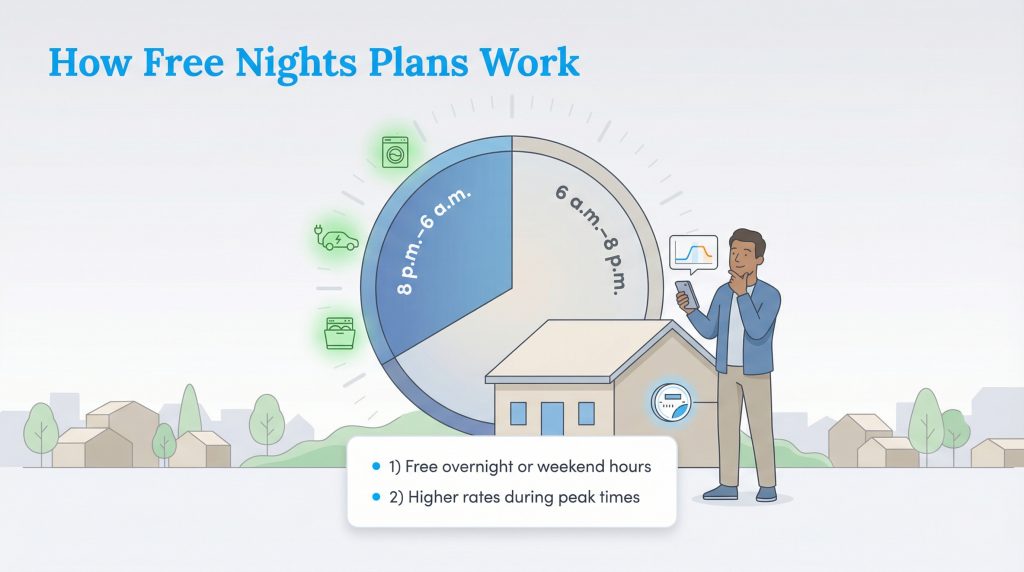
Understanding the mechanics behind these contracts requires looking at how grid demand fluctuates. These packages are essentially specialized time of use electricity plans that divide your billing into distinct pricing periods based on the time of day. Energy providers can offer these unique structures because your home is equipped with a smart meter, a digital device that precisely tracks your kilowatt-hour consumption down to the hour or even the 15-minute mark. When you’re shopping for electric plans, you’ll notice these companies define specific windows where your energy charge drops to absolutely zero.
To balance the scales, providers rely on off-peak electricity rates to incentivize usage when the grid is quiet. For a standard free nights contract, the promotional window typically kicks in around 8:00 p.m. or 9:00 p.m. and lasts until 5:00 a.m. or 6:00 a.m. the following morning. Alternatively, free weekends plans usually zero out your charges starting Friday evening and stretching continuously until Monday morning. Outside of these designated free blocks, the provider charges a heavily inflated premium rate for every kilowatt-hour you consume.
The Energy Clock: Peak vs. Off-Peak Hours
Picture a giant “Energy Clock” hanging over your city. Electricity demand naturally spikes in the late afternoon and early evening when kids get home from school, air conditioners work overtime, and ovens turn on for dinner. Generating power during this peak frenzy is notoriously expensive for the grid. Providers offer free nights simply to persuade customers to shift their heavy appliance usage to the quiet overnight hours. If you want to dive deeper into how this delicate grid balancing acts affects pricing models, you can read up on time-based electricity rates through the Department of Energy.
What Is the Catch? Fixed Rate vs. Free Nights and Weekends
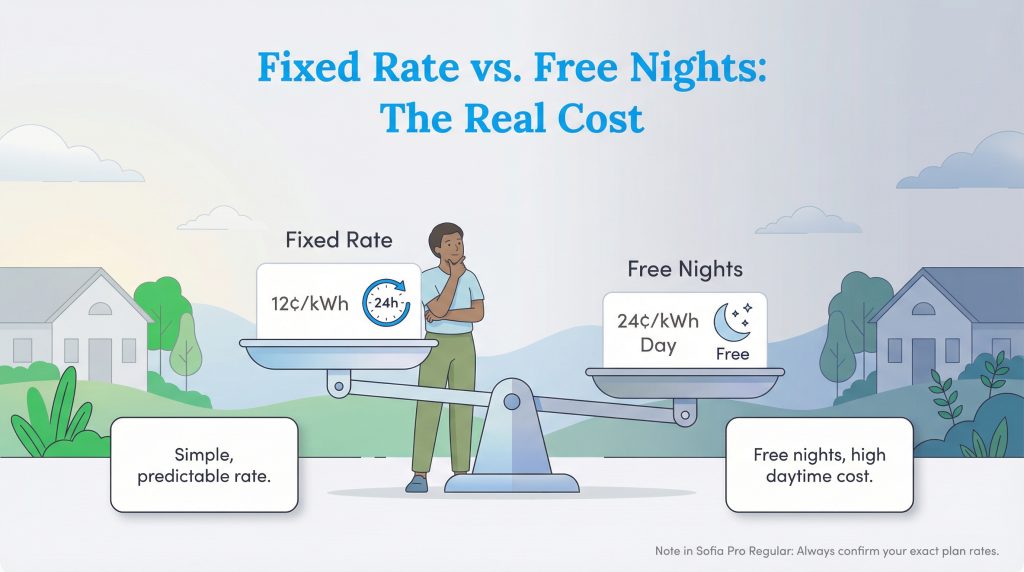
Let’s be entirely straightforward: for the average person with a normal schedule, these plans are generally not worth the trouble. Energy companies design these products knowing that most households can’t drastically alter their daily routines. When you weigh a fixed rate vs free nights and weekends side by side, the financial reality becomes jarring. As an illustrative example, a standard fixed-rate plan might charge you a steady 12 cents per kilowatt-hour around the clock, offering complete predictability regardless of when you cook or run the dryer.
Conversely, a free nights plan will gladly give you energy for nothing at 2:00 a.m., but might charge an estimated 24 cents per kilowatt-hour during the day. Since the bulk of a normal family’s energy consumption happens between morning and evening, you end up paying double the normal rate for your most active hours. The math rarely falls in favor of the consumer unless they are incredibly disciplined about shifting their habits. Always verify exact rates with your specific plan’s terms.
How to Calculate If a Free Nights Plan Will Save You Money
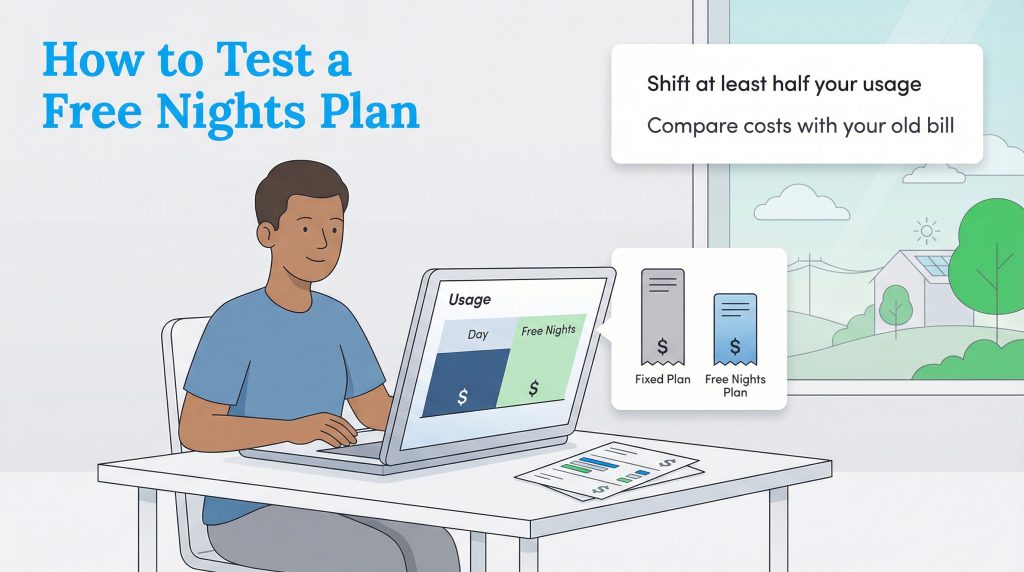
The only reliable way to know if a time-of-use plan fits your household is to run a break-even calculation using your historical data. Start by pulling your past energy bills to find your average monthly kilowatt-hour consumption. Next, estimate how much of that usage you can realistically shift into the free window. Most consumers find they need to move half or more of their total consumption to the off-peak hours to break even against a standard fixed-rate plan.
Once you have your estimates, compare them against the prospective plan’s rates. Multiply your projected daytime usage by the premium daytime rate, add in any base charges, and include the delivery fees that apply to both your paid and “free” hours. If the calculated total is lower than what you would pay on a straightforward fixed-rate contract, the promotional plan might be a smart, cost-effective choice for your home.
How to Read the Electricity Facts Label (EFL) for Easy-to-Miss Fees
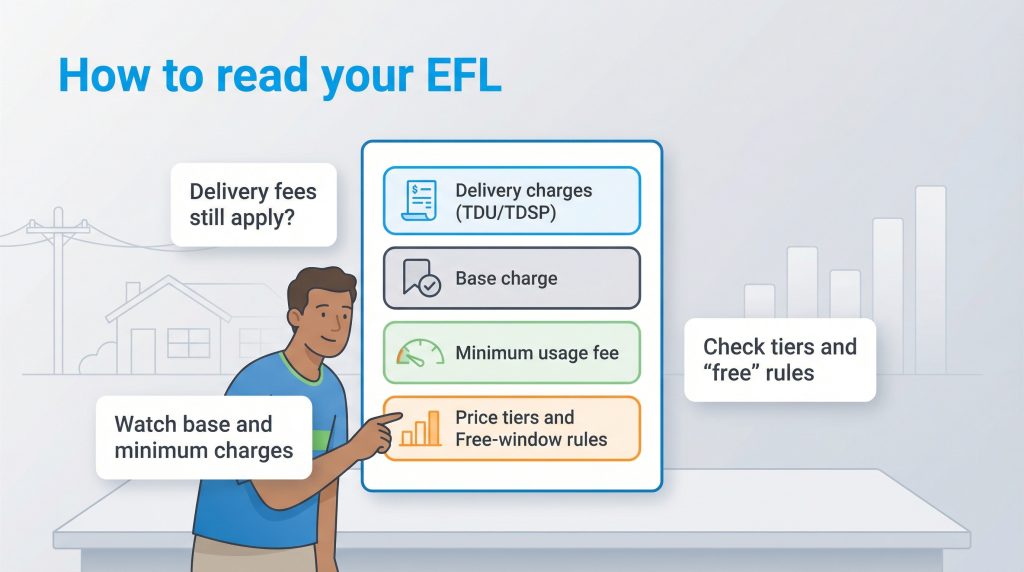
The single most important document you will encounter when shopping for power is the Electricity Facts Label, commonly known as the EFL. It operates as the nutrition label for your electricity plan, exposing the hidden fees that clever marketing tries to obscure. When a company advertises “free” power, they are strictly referring to the energy supply charge. They aren’t necessarily waiving the utility delivery charges.
You must scour the EFL to spot base charges, minimum usage penalties, and the sneaky pass-through costs from your local transmission and distribution utility. In Texas, these are known as TDU or TDSP fees. Some providers still bill you for these delivery fees during your “free” window, meaning you’re still paying a few cents per kilowatt-hour. If you’re curious about the intricate details surrounding these local delivery costs and generation expenses, the U.S. Energy Information Administration offers an excellent breakdown of the factors affecting electricity prices nationwide.
When reviewing your EFL, be sure to look for these specific line items:
- Delivery charges: Look for separated local utility fees (often labeled TDU or TDSP) that may still apply during off-peak windows.
- Base charge: Note any flat monthly fees applied regardless of your total consumption.
- Minimum usage fees: Check if you are penalized for using too little electricity during the billing cycle.
- Price tiers: See how the advertised rate changes based on exactly 500, 1,000, or 2,000 kilowatt-hours of use.
- Free-window rules: Confirm if the “free” period waives both the energy supply charge and the delivery charge, or just the supply charge.
The “Is It Worth It?” Self-Assessment Checklist
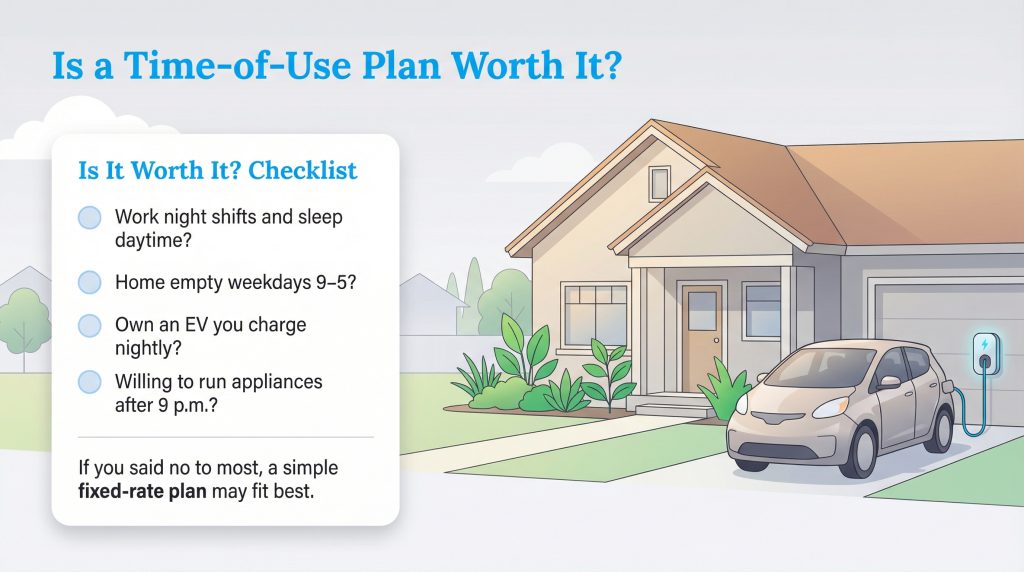
Figuring out if you can genuinely beat the system comes down to an honest look at your daily lifestyle. Before you lock yourself into a tricky contract, ask yourself these qualifying questions:
- Do you consistently work night shifts and sleep during the day?
- Is your house completely empty Monday through Friday during normal business hours?
- Do you own an electric vehicle that requires nightly charging?
- Are you willing to wait until after 9:00 p.m. to wash clothes or run the dishwasher?
If you answered “no” to the majority of these questions, you should skip the promotional plan and opt for a traditional fixed-rate plan instead. Consistency almost always beats complexity for normal families. When comparing energy plans in Houston or any other deregulated market, your past usage data serves as the best predictor of your future bills.
Smart Home Synergy: Automating Your Savings
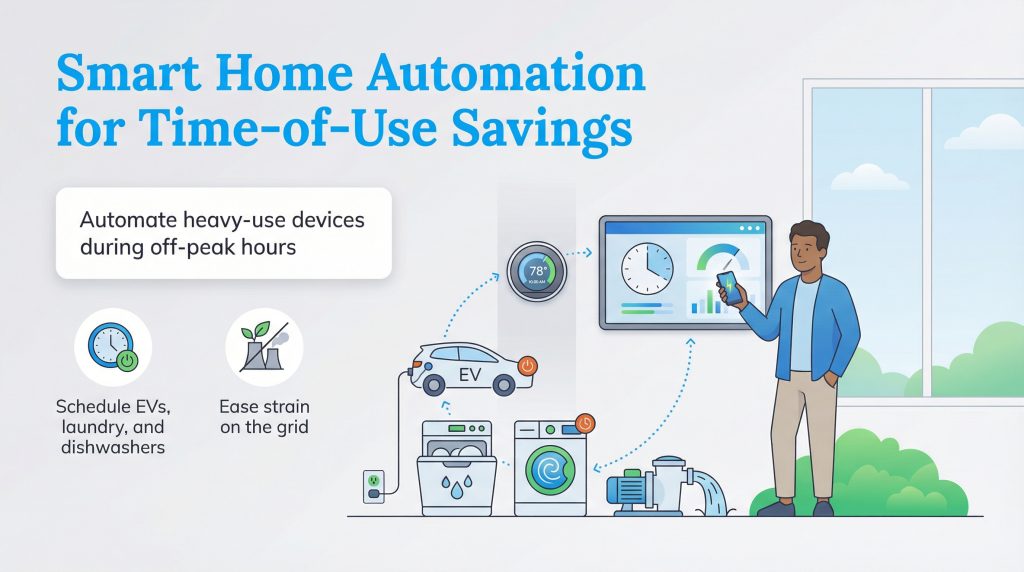
If you passed the self-assessment and want to tackle a time-of-use contract, technology will be your greatest ally. Relying on your own memory to turn on appliances at 9:00 p.m. is a recipe for expensive mistakes. Instead, you need to automate your savings by connecting your heavy-hitting devices to a smart home ecosystem. Modern smart thermostats can be programmed to super-cool your house during the final “free” hour in the early morning, letting the lingering chill keep your home comfortable while the expensive daytime rates kick in.
You can also use delayed start features to schedule EV chargers, dishwashers, washing machines, and pool pumps to exclusively run during your off-peak windows. Approaching your electricity consumption this way acts as an eco-conscious alternative to standard grid usage, easing the heavy strain on local power plants during high-demand afternoons.
Making the Right Choice for Your Home Energy
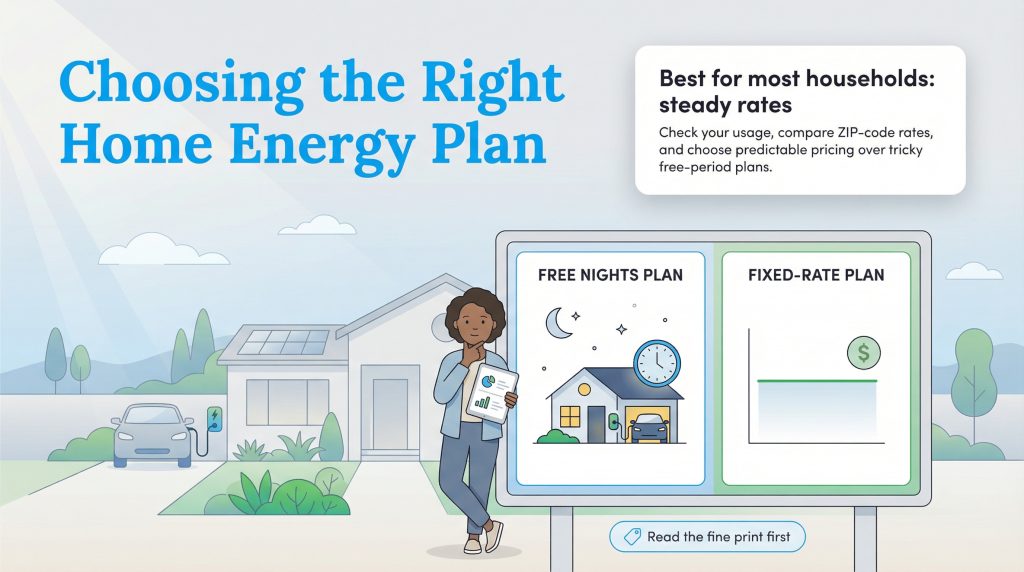
At the end of the day, free nights and weekends electricity plans are incredibly powerful tools for night-shift workers and electric vehicle owners. However, they easily trap average households with punishing daytime rates that secretly drive up monthly costs. The allure of a zero-cent energy charge is strong, but you have to do the math on your historical usage before signing a legally binding contract.
We always encourage our readers to prioritize steady, predictable pricing unless they possess the strict discipline to shift massive amounts of consumption into the dark. If you’re struggling to manage your usage, there are plenty of other strategies to lower your overall electric bill without resorting to a stressful complex billing structure. Take your time, read the fine print, and leverage official state shopping portals to compare the exact rates available for your ZIP code.
Frequently Asked Questions About Free Nights or Weekends Plans
Are free nights and weekends electricity plans worth it?
How do free nights and weekends plans work?
Do you still pay delivery charges during “free” hours?
Is it better to have a fixed rate or free nights?
When do free nights usually start on an electricity plan?
Will a free weekends plan save me money if I work from home?
About the Author

David has been an integral part of some of the biggest utility sites on the internet, including InMyArea.com, HighSpeedInternet.com, BroadbandNow.com, and U.S. News. He brings over 15 years of experience writing about, compiling and analyzing utility data.