
Understanding how usage credits affect your monthly electricity bill can help you decide if these plans will save you money or cost you more.
Key Takeaways
- Bill credit plans offer a specific dollar discount on your energy bill when you use a targeted amount of electricity each month.
- Hitting the exact usage tier is critical, as missing the required kilowatt-hours (kWh) can result in a noticeably higher average rate.
- Reviewing the Electricity Facts Label (EFL) is the best way to uncover the true math behind advertised teaser rates and decide if the plan fits your home’s energy habits.
Shopping for power in a deregulated market often feels like solving a complex math puzzle, especially when providers advertise massive discounts on a new bill credit electricity plan. These plans are common in deregulated markets like Texas, and we want to help demystify exactly how these structures operate. By exploring the details of these contracts, we’ll help you figure out if chasing these targets is a smart financial move for your household.
What Is a Bill Credit Electricity Plan?
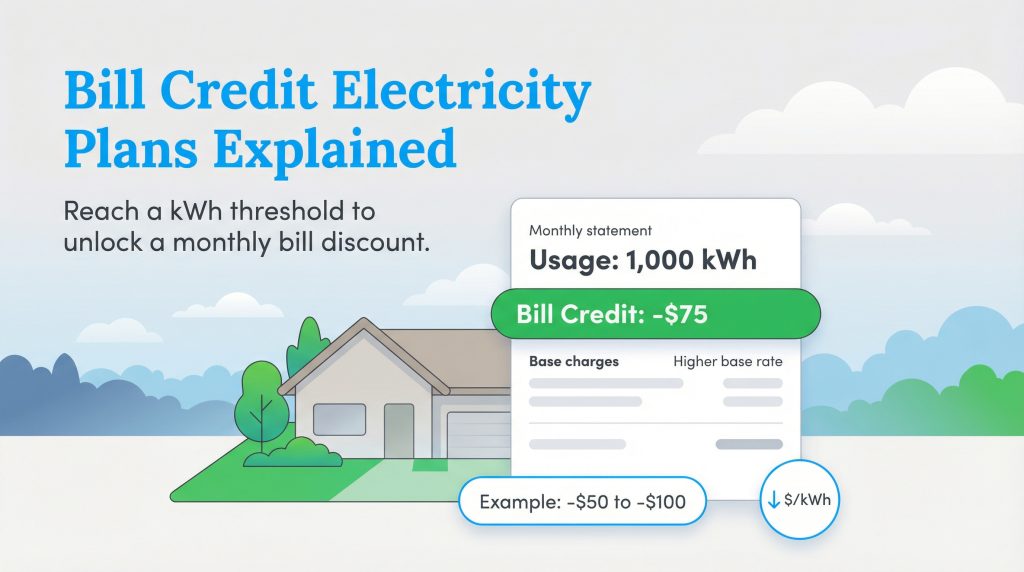
When comparing your electric plan options, you might notice offers promising a significant discount if you reach a certain threshold. A bill credit electricity plan gives you a set dollar amount off your monthly statement, usually around $50 to $100, strictly for hitting a specific usage target. Many plans structure credits around common EFL tiers like 500, 1,000, and 2,000 kWh.
If you’re wondering how do bill credit plans work in practice, think of them as an incentive program with a catch. The underlying base rate for the electricity itself is often higher than standard market prices. However, once your home consumes enough energy to cross that specific threshold, the provider applies the credit. This sudden discount offsets the higher base cost, ultimately dropping your average price per kWh for that billing cycle.
The Math Behind the 1000 kWh Bill Credit Plan
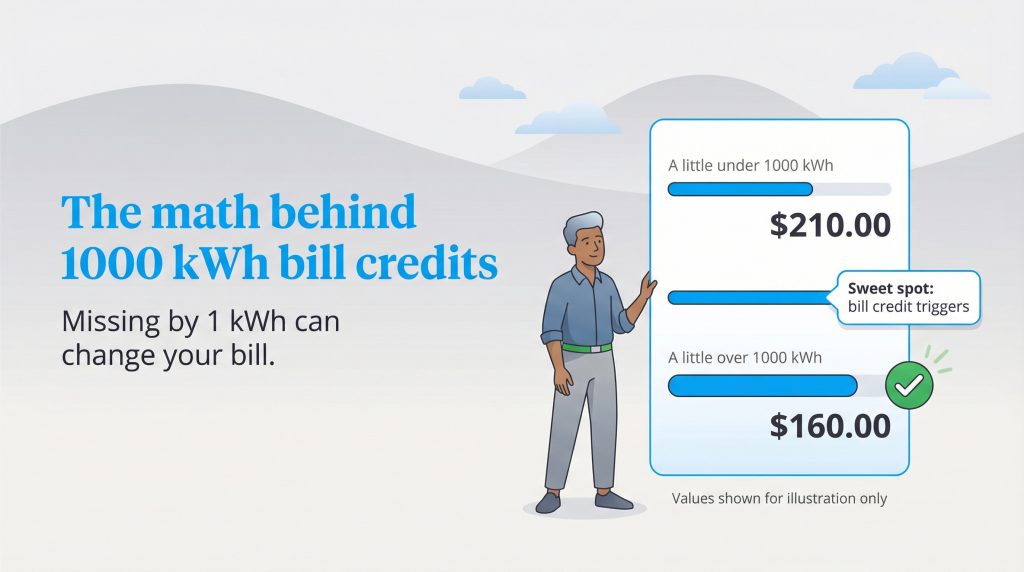
Providers heavily market the 1000 kWh bill credit plan because 1,000 kWh is a commonly used benchmark in advertised average-price tables. They advertise an incredibly low price, like 9.9 cents per kWh, but that number only exists if the discount perfectly applies. This pricing strategy represents one of the most common electricity teaser rates. The underlying base rate might actually sit closer to 16 cents per kWh. If your home only uses 999 kWh, that generous credit never triggers, and your monthly statement can be noticeably higher because the discount doesn’t apply.
Missing the target by a single kilowatt-hour dramatically shifts the financial reality. To avoid falling into this trap, you need to see exactly how the numbers play out across different property sizes. Below is a simplified, hypothetical breakdown showing why hitting the exact sweet spot matters. Please note that this example excludes standard charges like TDU delivery fees, taxes, and monthly base fees, which vary by utility territory and plan.
Simulated Bill Credit Math (Hypothetical Example)
| 500 kWh (Small Apartment) | 1,000 kWh (Medium Home – Target Hit) | 1,500 kWh (Large Home) |
|---|---|---|
| $80 Base Cost | $160 Base Cost | $240 Base Cost |
| No Credit Applied | $61 Credit Applied (1,000 to 1,499 kWh band) | No Credit Applied (Fell outside the 1,000 to 1,499 kWh band) |
| $80 Total Bill (16¢/kWh) | $99 Total Bill (9.9¢/kWh) | $240 Total Bill (16¢/kWh) |
Bill Credit vs Fixed Rate Electricity Plans
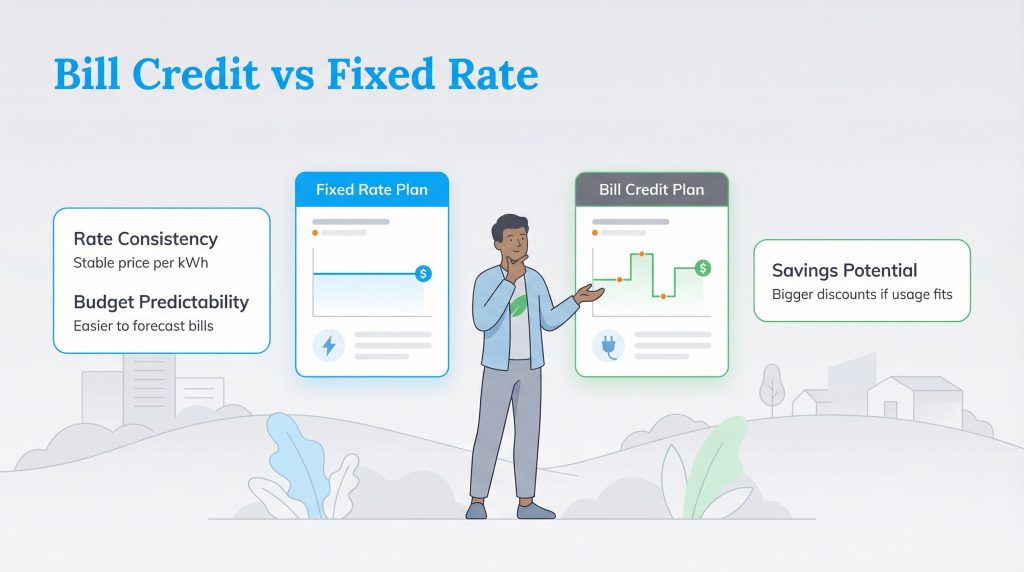
When evaluating a bill credit vs fixed rate contract, the biggest difference comes down to risk tolerance. A true fixed-rate plan charges the exact same price per kilowatt-hour regardless of how much energy your household consumes. Whether you run the air conditioning constantly in July or barely use any power in November, your rate remains steady. This structure provides supreme budget stability and peace of mind.
Conversely, credit-based options offer potentially steeper discounts but carry significant volume risk. If your habits fluctuate, you might miss the discount window entirely. Retail energy providers like Gexa Energy frequently offer these credit-based structures to attract shoppers looking for the absolute lowest advertised price.
You can actively filter and shop for both types of agreements on platforms like the Texas official Power to Choose marketplace. As you browse, keep these fundamental differences in mind:
- Rate consistency: Fixed rates stay flat per kWh, while credit plans fluctuate wildly based on total volume.
- Budget predictability: Fixed options make forecasting your expenses easier.
- Maximum savings potential: Credit plans can yield a lower overall bill, but only if you hit the required targets perfectly every month.
How to Read the Electricity Facts Label (EFL) for Usage Credits
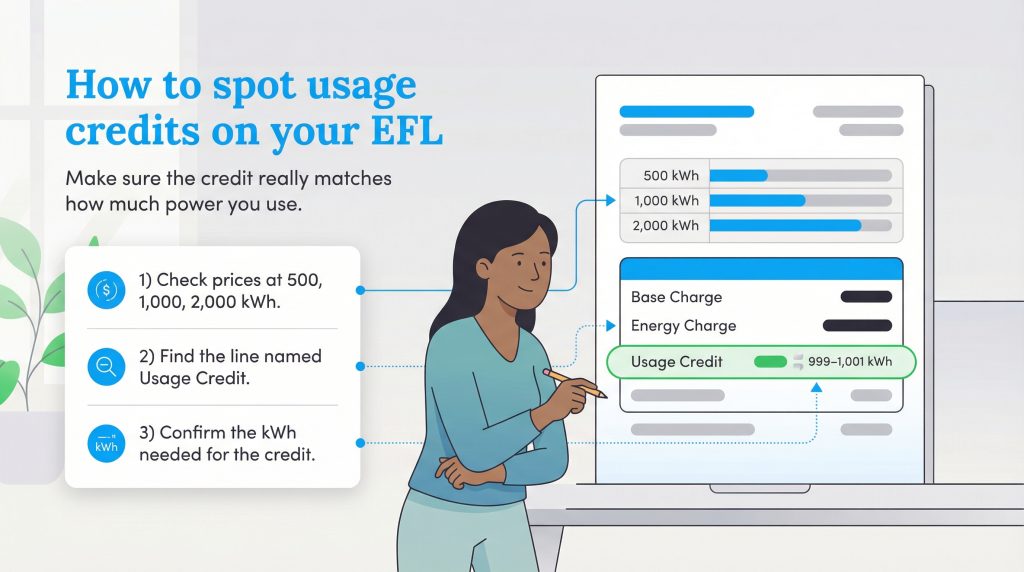
The Electricity Facts Label acts as the ultimate nutrition label for energy plans. It strips away flashy marketing and exposes the true cost of the product. Learning how to spot the electricity facts label usage credit is the single most important step you can take to protect your wallet from deceptive pricing.
Before you agree to any new contract, pull up this document and verify the math. Here’s exactly where you should focus your attention:
- Look at the top average price chart for the 500, 1,000, and 2,000 kWh usage tiers to see how drastically the rate shifts.
- Find the specific “Usage Credit” line item located under the Base Charge and Energy Charge section.
- Note the exact minimum, and sometimes maximum, kWh limits required to trigger the discount.
Where the Credit Hides on the EFL (And What Else You’ll Still Pay)
When reviewing the EFL, it is crucial to understand that the “average price” shown in the advertisements often highlights the single best usage tier where the credit applies. However, your actual bill comprises several distinct parts. The energy charge is what you pay for the electricity itself, while the base charge is a flat monthly fee from your retail provider. Additionally, you will see Transmission and Distribution Utility (TDU) delivery charges, which are regulated fees passed through by the local utility to maintain the poles and wires.
Even if a generous usage credit offsets your energy charge for the month, those TDU delivery charges and base fees still apply. This is why a plan advertising 9.9 cents per kWh at exactly 1,000 kWh can jump to 16 cents or more at 999 kWh, as the base and delivery charges are no longer masked by the sudden application of a $50 or $100 credit.
Are Bill Credit Electricity Plans Worth It for Your Home?
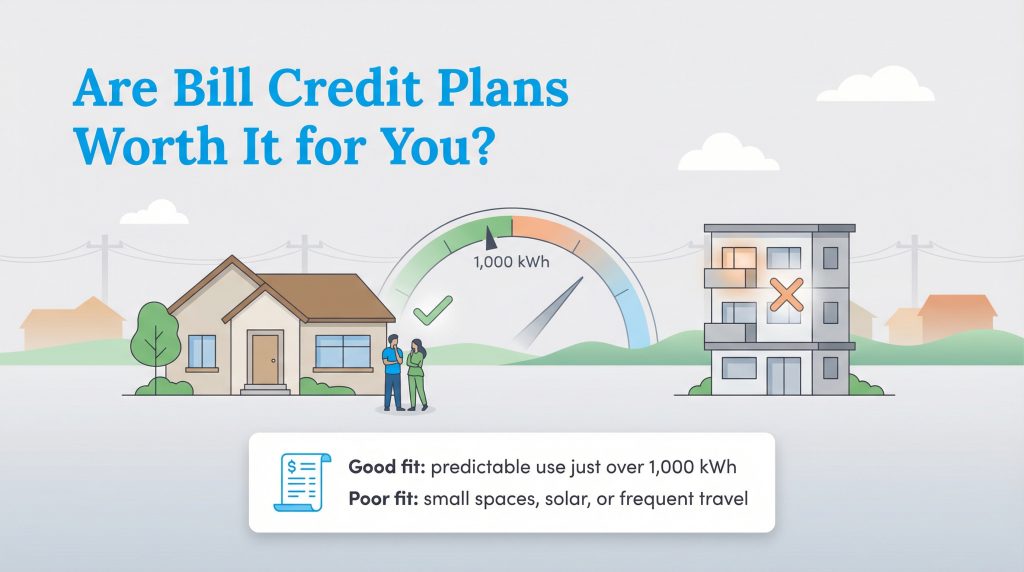
Deciding whether these structures fit your lifestyle requires an honest assessment of your consumption habits. So, are bill credit electricity plans worth it? They absolutely can be for homes with highly predictable energy usage or large families who consistently use just over 1,000 kWh every month. If your usage resembles a flat line year-round, capturing that monthly discount is easy. However, these contracts are terrible fits for small apartments, homes equipped with solar panels, or individuals who travel frequently.
To help you decide if this type of contract makes sense for your household, consider the following scenarios:
| Energy Usage Profile | Best Plan Match |
|---|---|
| Your usage is steady year-round (e.g., always between 1,000 and 1,500 kWh). | A bill credit plan may work well and provide consistent savings. |
| Your usage swings seasonally (high in summer, low in winter). | A traditional fixed-rate plan is safer to avoid missed credits. |
| You live in a small apartment, travel frequently, or have solar panels. | Avoid bill credit plans, as you likely won’t hit the minimum thresholds. |
We also have to consider the environmental impact. Purposefully leaving lights on or running appliances just to hit a 1,000 kWh threshold defeats the entire purpose of conservation. Wasting power to secure a discount isn’t an environmentally mindful choice. Instead, you should focus on proven strategies to save on your electric bill through natural efficiency and select a plan that naturally fits your consumption profile without requiring you to game the system.
Deregulated market choices extend well beyond just one or two states. Whether you live in the South or are comparing options on PA Power Switch, you’ll likely encounter these tiered structures. Take the time to evaluate your historical data before signing up.
Making the Smart Choice for Your Home’s Energy Use

Harnessing a targeted discount can serve as a fantastic financial tool, provided you understand your historical energy usage perfectly. These tiered programs reward consistency, but they demand a careful review of the EFL to ensure a high base rate doesn’t catch you off guard. Take control of your data, read the fine print, and choose an energy plan that truly supports your household’s daily rhythms and budget goals.
Frequently Asked Questions About Bill Credit Electricity Plans
Do bill credit plans roll over to the next month?
What happens if I use 999 kWh on a 1,000 kWh bill credit plan?
Why do electric companies offer usage credits?
Can I get a bill credit plan with renewable energy?
How do I know my average monthly electricity usage?
About the Author

LaLeesha has a Masters degree in English and enjoys writing whenever she has the chance. She is passionate about gardening, reducing her carbon footprint, and protecting the environment.